Israelis cast ballots Tuesday in Knesset race with no projected winner
Polls indicate a likely stalemate in the 120-seat parliament, leaving Israel vulnerable to prolonged negotiations or a repeat of the five election cycles held between 2019 and 2022.
By Bianca Herrera ·
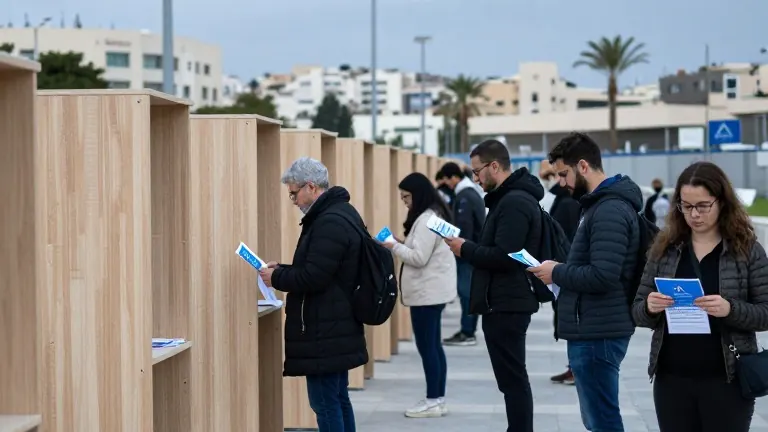
Israelis are voting Tuesday for 120 seats in the Knesset, a parliament where most polls show neither the ruling coalition nor the opposition bloc has a path to a stable majority. Prime Minister Benjamin Netanyahu and his challengers face a tight contest that could leave the country without a clear government for weeks or months.
The vote takes place three years after the October 7, 2023, attacks by Hamas, an event Israeli authorities have acknowledged as the deadliest in the country’s history since 1948. The nation remains engaged in military operations in Gaza, Lebanon, and Syria, with Netanyahu advocating for a third round of direct conflict with Iran.
Right-leaning pollsters favor Netanyahu’s right-wing and religious bloc, while left-leaning firms project a win for the change bloc. However, nearly all surveys agree that neither side will secure the 61 seats required to form a government unilaterally. Yohanan Plesner, president of the Israel Democracy Institute, described an indecisive outcome as the most likely result.
Netanyahu, Israel’s longest-serving prime minister, is campaigning on the premise that only he can form a government without relying on Arab parties. He argues that his ongoing campaigns in Gaza, Lebanon, and Iran require his continued leadership to prevent Iran from obtaining nuclear weapons. His slogan rhymes in Hebrew: "Either right wing or Palestine, either right wing or a nuclear bomb."
President Donald Trump endorsed Netanyahu last week, stating that if Israel chooses a different leader, the United States might have to handle the conflict with Iran alone. Trump said, "If Israel has the wrong Leader, which would be anyone other than Bibi, America will have to do this work ourselves, and I am not inclined to do so."
Leading the opposition is Gadi Eisenkot, the former military chief who heads the centrist Yashar party. Eisenkot, who lost his son and two nephews in Gaza, is campaigning on a promise to launch a state inquiry into the intelligence failures of October 7. He accused Netanyahu of relying on fear-mongering, including posting an AI-generated image of a nuclear mushroom cloud over Tel Aviv.
"This time, it won’t work for him," Eisenkot said in response to Netanyahu’s rhetoric. His campaign features a high proportion of female candidates, contrasting with the male-dominated Likud list. Uzi Aharoni, a 73-year-old engineer from Tel Aviv, supported Eisenkot as a leader who would prioritize the people over his own family.
Voter turnout will be a deciding factor, particularly among Arab Israelis who make up about 20% of the population. Jehad Abomoch, a cafe owner in Baqa al Gharbiya, said many Arab voters feel they have no hope under Netanyahu and are motivated to prevent a coalition with far-right allies. Two new parties focused on ultra-Orthodox conscription are also hovering near the threshold for Knesset entry.
If no majority emerges, politicians may switch sides to form a coalition, a practice with deep roots in Israeli politics. Alternatively, the change bloc could attempt to form a minority government by securing more seats than the opposition, even if they do not reach 50% of the total. If negotiations fail, the country may face another election, as it did five times between 2019 and 2022.
Plesner noted that most politicians are not interested in returning to the polls, but the current margins make such a scenario possible. The counting process will take days or weeks to reveal the final seat distribution.
Source: CBS News