
Parking lot candy runs replace door-to-door walks as safety fears persist
Trunk-or-treating surged during the pandemic and remains popular, but critics argue the format reduces the holiday's traditional community interaction to a quick, parent-centric event.
By Bianca Herrera ·
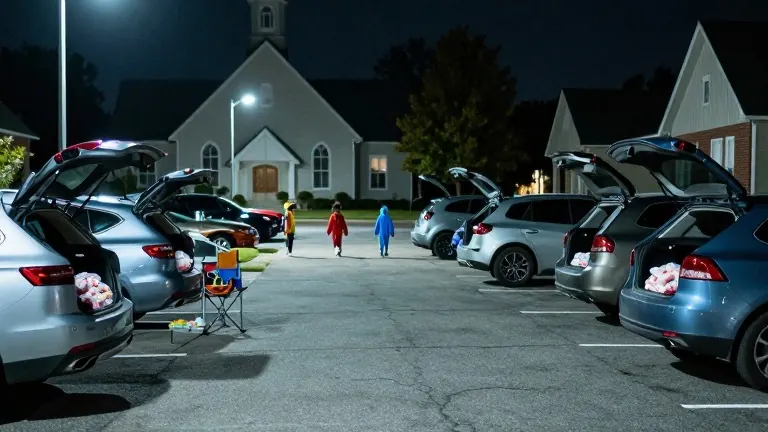
For many families in the United States, the Halloween experience has shifted from walking through neighborhoods to circulating through crowded parking lots. This change, known as trunk-or-treating, involves parents parking their vehicles in a designated area and opening the trunks to distribute candy to children. While the practice began in the 1990s, it gained widespread traction during the COVID-19 pandemic. Parents at the time cited social distancing as a primary motivator, believing that spaced-out cars offered a safer alternative to the close quarters of traditional door-to-door visits.
The format has persisted well beyond the height of the health crisis, evolving from a temporary health measure into a standard method for celebrating the holiday. Proponents argue that the controlled environment of a parking lot allows adults to monitor children more closely. This perceived safety net appeals to parents who want to manage the risks associated with trick-or-treating, even if those risks are often exaggerated.
Critics of the trend, however, contend that trunk-or-treating diminishes the core appeal of the holiday. They point out that the traditional practice relies on the spontaneity of moving from house to house and the community trust required to venture into unfamiliar areas. By compressing the event into a single location, the activity becomes shorter and less physically demanding. Children often collect large amounts of candy in a matter of minutes, reducing the duration of the evening and the opportunity for independent exploration.
The shift also changes the dynamic for adults. Many parents describe the event as similar to tailgating a sporting event, utilizing the time to socialize, consume beverages, and rest in folding chairs. This arrangement allows caregivers to keep a constant eye on their children, addressing anxieties about neighborhood safety and the unknown. For some, this level of oversight is a necessary adjustment to a world where technology allows for constant tracking of a child's location.
Debate exists over the validity of the safety concerns driving this change. Common fears, such as neighbors contaminating candy with razor blades or poison, have been largely debunked by recent studies. These incidents are considered rare and a form of moral panic rather than a statistical threat. Despite this data, the preference for a contained environment remains strong among many households who prioritize a managed experience over a traditional one.
The format is not without practical advantages in specific contexts. In rural areas or urban zones with limited walkable streets, a centralized parking lot at a school or church can provide a necessary alternative. In these locations, the density of homes may not support a traditional route, making the trunk-or-treat model a functional solution for community participation.
The practice has become embedded in the holiday routine for a growing number of families. It reflects a broader cultural preference for convenience and risk management in leisure activities. As the tradition evolves, the balance between parental supervision and childhood independence continues to be a point of discussion among communities.
Faith Richardson, a writer for The Pitt News, notes that while the method is not inherently negative in every scenario, its widespread adoption may alter the character of the holiday. She suggests that the rush to optimize safety and convenience could contribute to a culture of impatience, where the slower, more exploratory aspects of the event are sacrificed for efficiency.