Fear for fun: a neuroscientist explains the Halloween thrill
An FIU researcher describes how three brain systems interact to convert a fright into an enjoyable experience.
By Austin Reed ·
Matthew Sutherland, a cognitive neuroscientist at Florida International University's Center for Children and Families, says the brain converts Halloween scares into pleasure through a sequence of neural events. He describes a three-part process involving fear detection, rational assessment, and chemical reward.
The sequence begins with the amygdala, which Sutherland calls the brain's alarm system. A jump scare or sudden scream causes the amygdala to flood the body with adrenaline and stress hormones, raising heart rate and sharpening senses. "The amygdala's job is to protect us," Sutherland said. "It makes our hearts race, sharpens our senses, and keeps us alert, even when we know we're safe."
The prefrontal cortex then evaluates the threat. Because it can reason that a zombie is an actor or a roller coaster is engineered for safety, the cortex signals that no real danger exists. At that point, dopamine releases through the brain's reward system, and the experience reads as enjoyable rather than threatening. "Our brains let us experience the physiological rush of fear while knowing we're not in real danger," Sutherland said. "That combination transforms anxiety into excitement."
Sutherland notes that children reach this balance differently. The amygdala matures early, while the prefrontal cortex develops over a longer period, so younger children may treat a pretend threat as real. Most children begin to find fear enjoyable in appropriate settings around age seven or eight. He recommends that parents preview Halloween decorations in daylight, let children select age-appropriate scares, and allow them to take the lead in scaring others. "When kids realize they can calm down after being startled, they learn resilience," Sutherland said.
Fear also has a social component. Sutherland says shared scares cause the release of oxytocin, a hormone linked to trust and bonding. "Facing fear together acts like social glue," he said. Individual differences matter as well: children with anxiety may have amygdalae that react more strongly, and children with ADHD often show lower dopamine activity, which may lead them toward louder screams and faster rides.
Sutherland compares the process to an orchestra, with the amygdala as the drum, the prefrontal cortex as the conductor, and the striatum providing the reward. The Center for Children and Families provides clinical services for children facing intense fear or anxiety. Information is available at ccf.fiu.edu or by calling 305-348-0477.
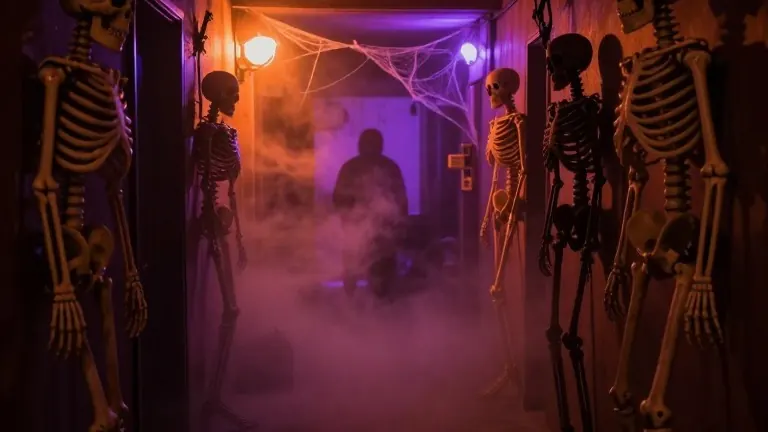
image_prompt": "A dimly lit hallway inside a Halloween attraction, orange and purple light spilling through fog, plastic skeletons and cobweb decorations along the walls, a shadowed figure in the distance, moody cinematic lighting, photorealistic, no people, no text, no logos."}]}