120 Speakers Packed into One Day as Judge Weighs Halt to Trump Arch
Federal officials say construction could begin Thursday, but a judge has ordered tight reporting rules to monitor progress on the 250-foot memorial.
By Austin Reed ·
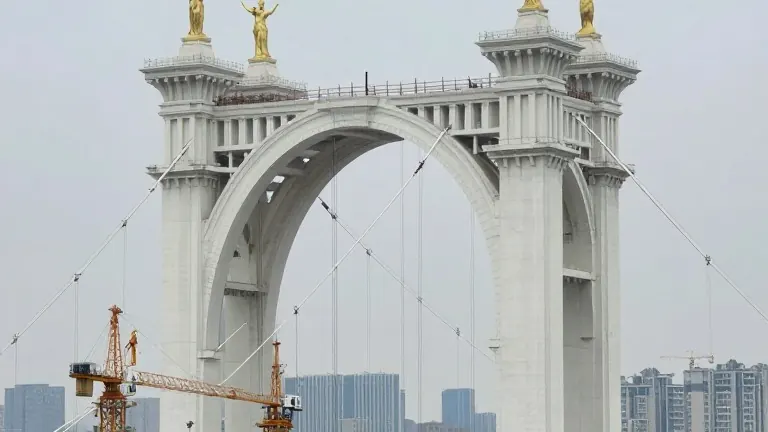
Nearly 120 citizens have registered to speak during a five-hour hearing that begins Thursday regarding a proposed 250-foot arch in Washington, D.C. The National Capital Planning Commission will consider final approval for the structure during a remote meeting that is the only item on its agenda. The high volume of public comment reflects widespread opposition from veterans, historic preservationists, and more than 100,000 people who have submitted written objections.
The administration has moved quickly to clear regulatory hurdles for the project. In May, the Commission for Fine Arts approved the design, which was not yet complete. In September, a federal council ended a historic preservation review that participants described as rushed. The arch is the only item on the planning commission's agenda, and the meeting is expected to conclude at 6 p.m. ET.
Legal challenges have intensified as the commission votes. Vietnam War veterans and an architectural historian are suing the administration, arguing the arch requires congressional approval. District Judge Tanya Chutkan consolidated this case with a separate lawsuit filed by D.C. and Virginia, which the jurisdictions called flagrantly illegal. Chutkan ordered the government to notify the court within one hour of any approval and within 30 minutes of any construction activity.
The Trump administration requested a 24-hour notice period, citing internal communication delays. The plaintiffs opposed the change, pointing to a previous incident where the government cut down 430 trees in D.C. with less than a day's warning. Chutkan kept the original short timeline. On Wednesday night, the government told the court that Grunley Construction Company may be arranging off-site preparations for construction mobilization.
The arch would stand in Memorial Circle on the bridge connecting the National Mall to Arlington National Cemetery. It would be more than twice the height of the nearby Lincoln Memorial. Renderings show a white concrete structure topped with three golden statues, including a winged woman holding a torch. The Federal Aviation Administration stated in September that the arch would not pose an airspace hazard if it is continuously lit in a specific manner.
President Trump announced on social media that the arch would serve as a military complex housing snipers and ammunition. Defense Secretary Pete Hegseth called the project a generational national defense opportunity in a court declaration. However, the final renderings do not mention drones or snipers. On Friday, Chutkan questioned how the government would accommodate up to 22,000 civilian visitors per day while installing military equipment.
The administration says construction will take two to three years with crews working 20 hours a day. The first six months would involve underground excavation and foundation work. D.C. and Virginia argue that the arch would disrupt traffic, hinder emergency response, and complicate flight paths for Reagan Washington National Airport. They contend that the harms cannot be remedied if construction proceeds.
The White House states the arch will enhance the visitor experience at Arlington National Cemetery. Trump said on Monday that it will be one of the great things we've ever done. The planning commission is widely expected to approve the design. If it votes yes, the Department of the Interior must provide final sign-off before ground can be broken.